We all know that big tech companies track user activity to some extent. But after monitoring my home network’s outgoing traffic, the reality of how much data is being silently sent to companies like Microsoft, Apple, and Google left me shocked.
I was especially alarmed to find that on a Sunday, when no one was working or doing school-related activities, massive amounts of telemetry data were still being sent from every device in the household. This is not just an occasional spike—it’s a constant stream of data, much of which goes unnoticed by most users.
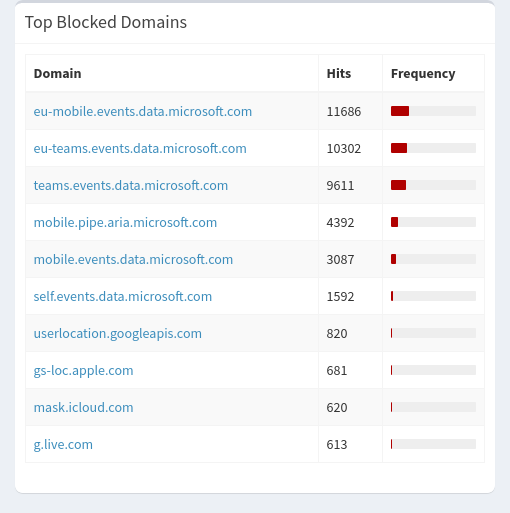
The scale of telemetry
In a 24-hour period, my Pi-hole blocked over 50,000 telemetry requests from just one day’s worth of activity—many of which came from Microsoft, Apple, and Google services. Most of these were from background processes running on our devices, even though no one was actively using them. On Sunday, the traffic was through the roof. Why?
This raised several questions in my mind:
- What data is being collected in these silent background processes?
- Why is so much telemetry traffic happening, even on a day when everyone was offline, celebrating a family event?
- And most importantly, how much information are we giving away without even knowing it?
Annual telemetry estimates: Mind-boggling
Based on my calculations, each person in our family (of 5) could be generating an estimated 4 million telemetry queries per year. Multiply that by a household of five, and you’re looking at nearly 20 million telemetry requests annually, all for data that benefits the company, not the user.
Here’s the thing: this constant data collection is not necessary for the average user to simply use their devices. The amount of information being collected has no other purpose than to feed the surveillance economy and improve the companies’ profit margins—not to enhance the user experience.
The cost to user privacy
I’ve been using Ubuntu on my workstation for a while now, and that was the first step in reducing the data sent back to Microsoft. But even now, on Apple and Google devices, I was shocked to see just how much location data, app usage, and system telemetry were being sent to corporate servers, without any consent.
The surveillance infrastructure behind these data requests is often invisible—users may not even realize their data is being collected, especially if they’re just browsing the web, using apps, or streaming a show on a Sunday afternoon. The sheer scale of it all is invasive.
Taking action: What can you do?
The good news is, there are ways to reclaim your privacy. Here are the steps I took:
- Deploy Pi-hole:
This has been a game-changer. By blocking telemetry and advertising domains at the network level, Pi-hole is now blocking 20 million telemetry requests annually for our family. And the best part? No one has noticed any issues with connectivity or functionality! - Switch to Alternative Operating Systems:
I recently moved from Windows to Ubuntu, which reduced a lot of telemetry traffic, especially from Microsoft. If you’re concerned about privacy, consider making the switch. - Opt for Privacy-Focused Services:
The more I look into alternatives, the more I realize that big tech isn’t the only option. Store your data locally on a NAS. Services like Signal (for messaging), and Brave (for browsing) put privacy first and let you regain control over your data. - Disable Telemetry Settings:
On Windows, turn off telemetry (if you’re using Windows Pro or Enterprise), and on iOS or Android, disable background syncing and location tracking where unnecessary. - Monitor Your Network:
The best way to understand what’s happening on your devices is to monitor outgoing traffic. Pi-hole is an excellent tool for this, but there are other ways to look at your network traffic as well (e.g., using Wireshark or GlassWire). You’d be surprised by what’s happening behind the scenes.
Why it matters
If the majority of people understood how much data is being collected on their devices, I think there would be a huge demand for greater transparency and more control over our data. Companies are making a fortune off of our privacy, and it’s time for us to start fighting back by using alternative solutions that don’t trade our personal information for profit.
I highly recommend everyone start monitoring their network traffic—you may be surprised at what you find. If you’re already on Windows, consider switching to Linux for better control over your operating system. And definitely look into using Pi-hole to block the constant barrage of telemetry requests that silently fill up your network traffic.
Call to action
It’s clear to me that the level of background surveillance from big tech is beyond excessive. The volume of telemetry traffic in my household is something I can’t ignore anymore, and I believe it’s time for everyone to start being more mindful of what’s going on in the background of their devices.
The more people that understand the scale of surveillance happening, the sooner we can start demanding greater transparency, privacy rights, and control over our data.
I’ve made the switch to privacy-focused solutions, and I’m confident that the effort is worth it. It’s a small step towards regaining control over my data, and I encourage everyone else to do the same.
Take back control
Let’s start taking back control over our privacy—monitor your network traffic, use tools like Pi-hole, and explore alternatives to big tech services. The more we share this message, the more we can push back against this unnecessary surveillance and help others realize what’s happening with their data.